Strange Days Indeed
(exhibition at Adjacent To Life Art Gallery, 341 East 10th St., New York City)
April 6 – May 3, 2024
Review by Marisa Malone (@friedegg_blues) / Instagram Link
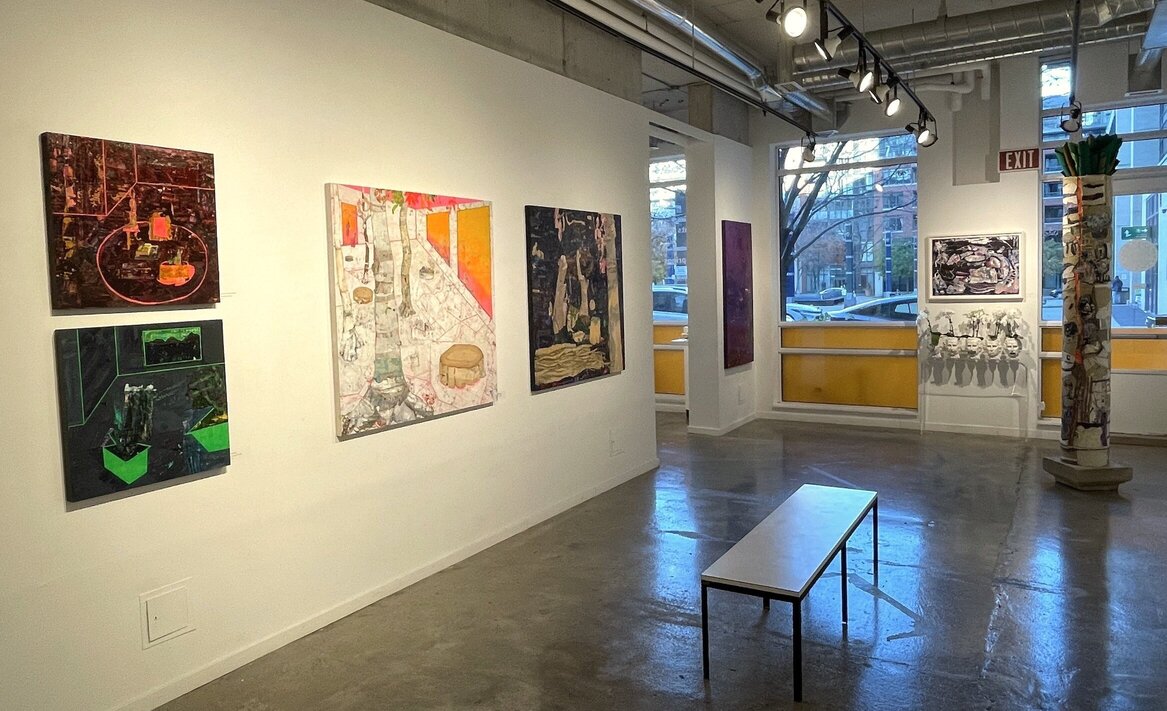
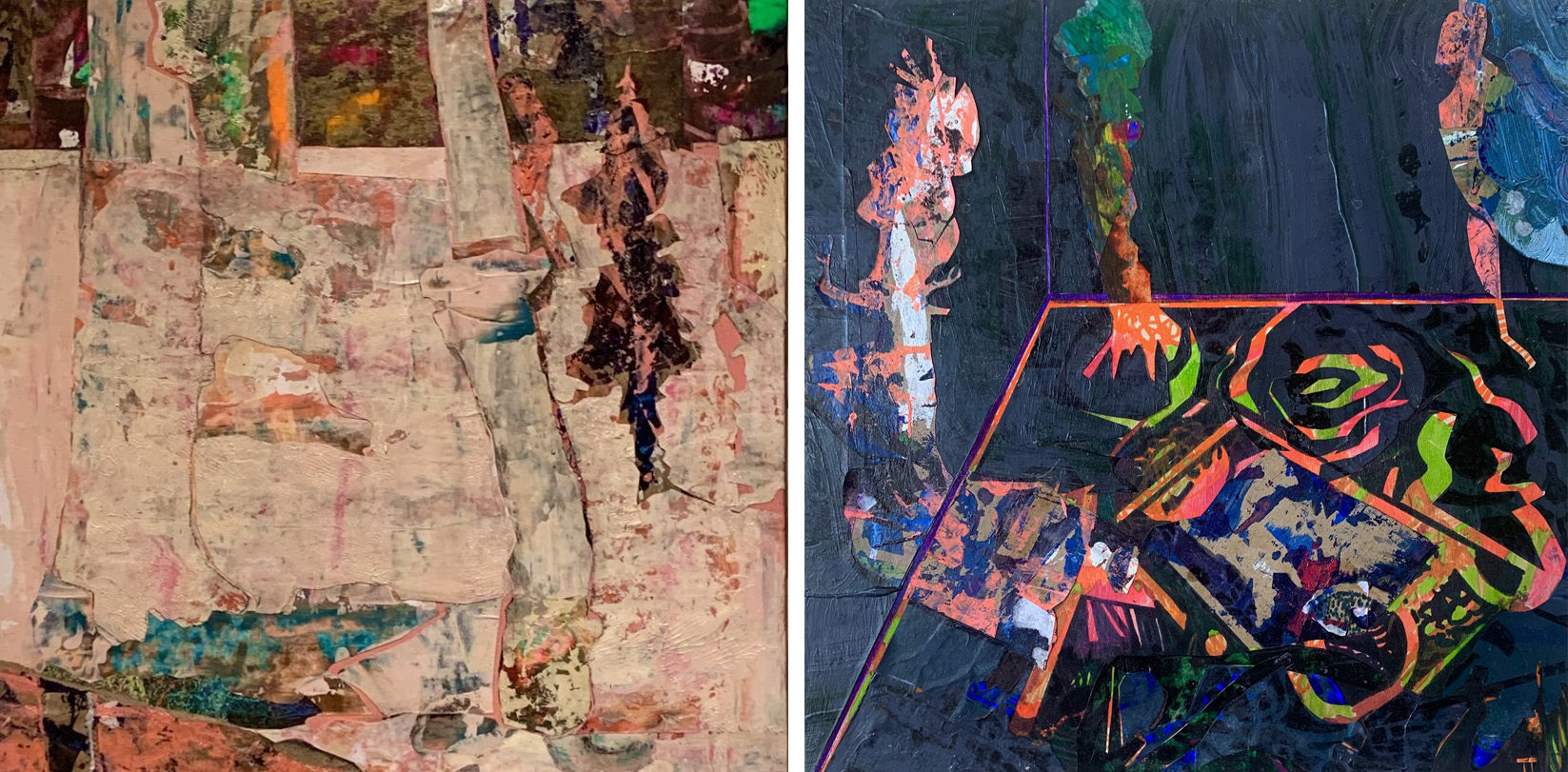
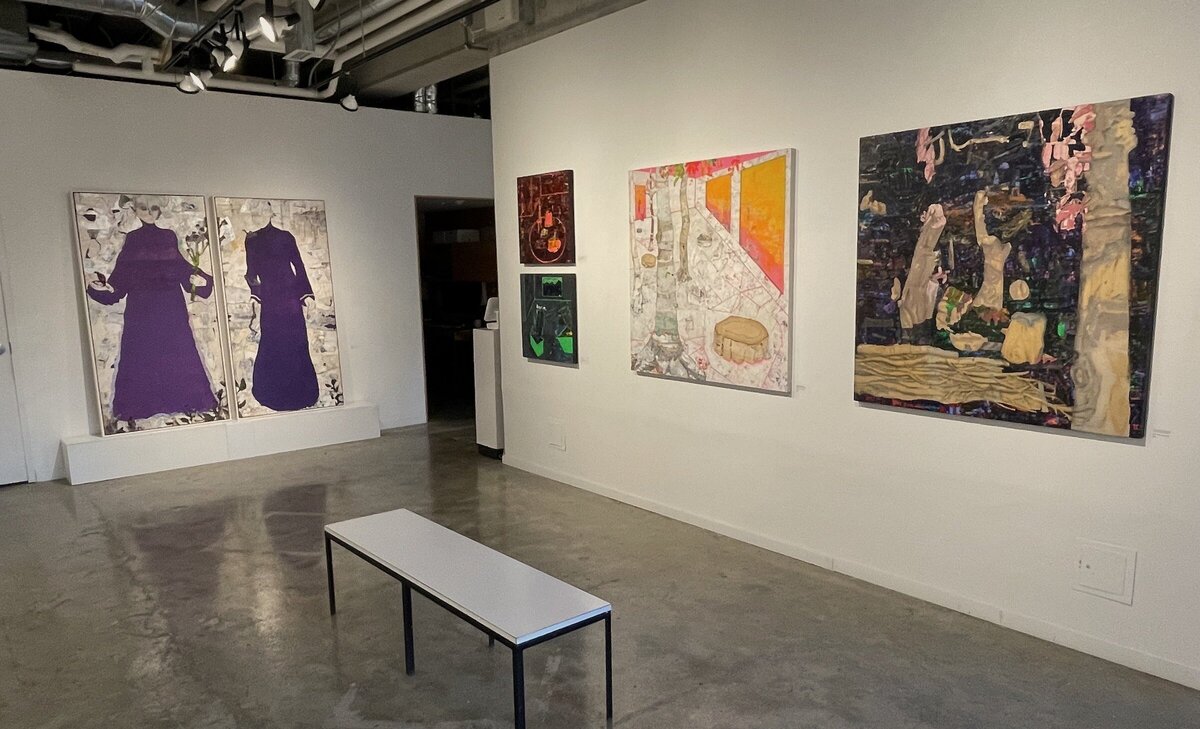
In Tracy Thomson’s latest paintings we see a shift further into abstraction, the interior space often present in her work is breaking down even more. There are suggestions of walls from the straight lines that cut across an otherwise fluid and layered background. Yet these walls are transparent, unable to fully contain or mark a solid distinction between spaces. There is a juxtaposition of boundaries: inside vs outside, the built environment vs wilderness, containment vs irrepressible growth.
These paintings emerge from an intuitive practice that mirrors nature’s building and restructuring of itself. Working with mixed media on wood panels, Thomson starts by painting pieces of cut paper, then plays with their arrangement seeking interesting contrasts, textures, and shapes. There is a lot of permission in her process, an allowance of happenstance and spontaneity. “I call them reconstructed paintings,” she explains, “[the process] can feel like the world rebuilding itself, no urban planning, just life regenerating wherever it can.”
Thomson imagines future landscapes with a mix of a post-apocalyptic vision and a persistent hopefulness, “I always think that organics will regenerate in any environment, providing a continuum of life, though it will look quite different with unfamiliar beings and new flora and fauna.” Her work unearths possibilities of what this new scenery might look like. Our experience of a landscape changing in ways we have yet to understand is a recurring tension for Thomson.
Long interested in the unseen elements that shape us and our environment, this series probes the underside of rocks, logs, the psyche, culture, and myths; “I’ve always been fascinated by what is hidden beneath, the underbelly in both nature and human nature… the unseen liminal space in the night.” Her work speaks to the messy, layered, symbolic elements of creation, destruction, and adaptation. The collaged paper, thick paint, embedded metallics, and found imagery, all combine to create a unique, uncanny world.
Hope Springs Eternal
(exhibition at Propeller Art Gallery, 30 Abell Street, Toronto)
November 15 – December 3, 2023
Review by Cassandra Johnson / Artoronto.ca link
On the walls at Propeller Art Gallery are 20 mixed-media artworks by Tracy Thomson—her story of hope and continuum within her world of regeneration and reconstruction. She “has no desire to create images of what already exists but instead, creates new worlds that transcend reality as we know it”. Even as each piece connects to this theme, each one has its own significance, illustrating the concept of a hopeful future.
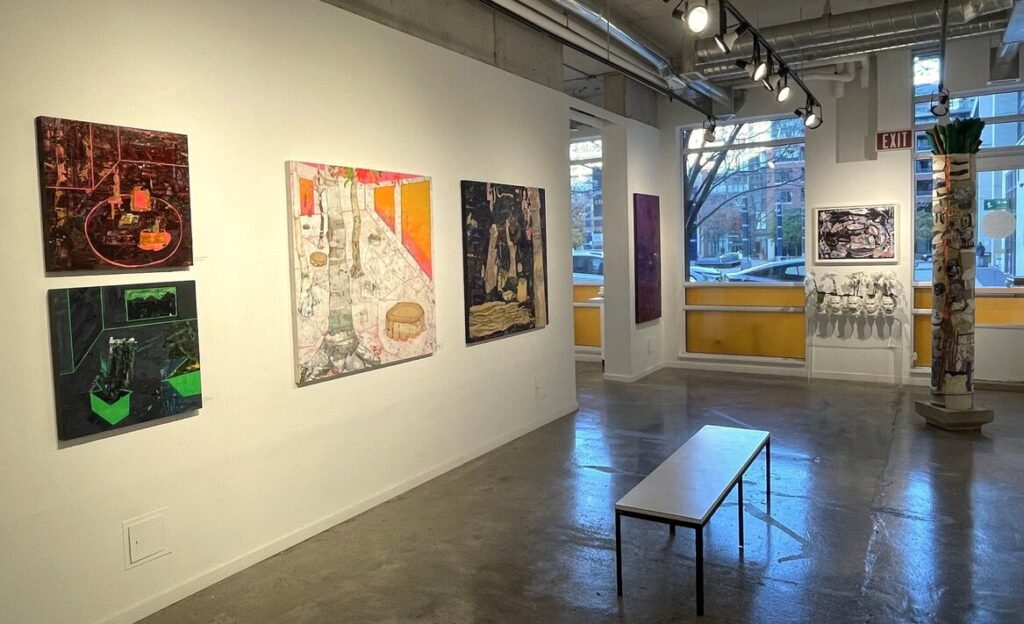
Installation view of Tracy Thomson, Hope Springs Eternal
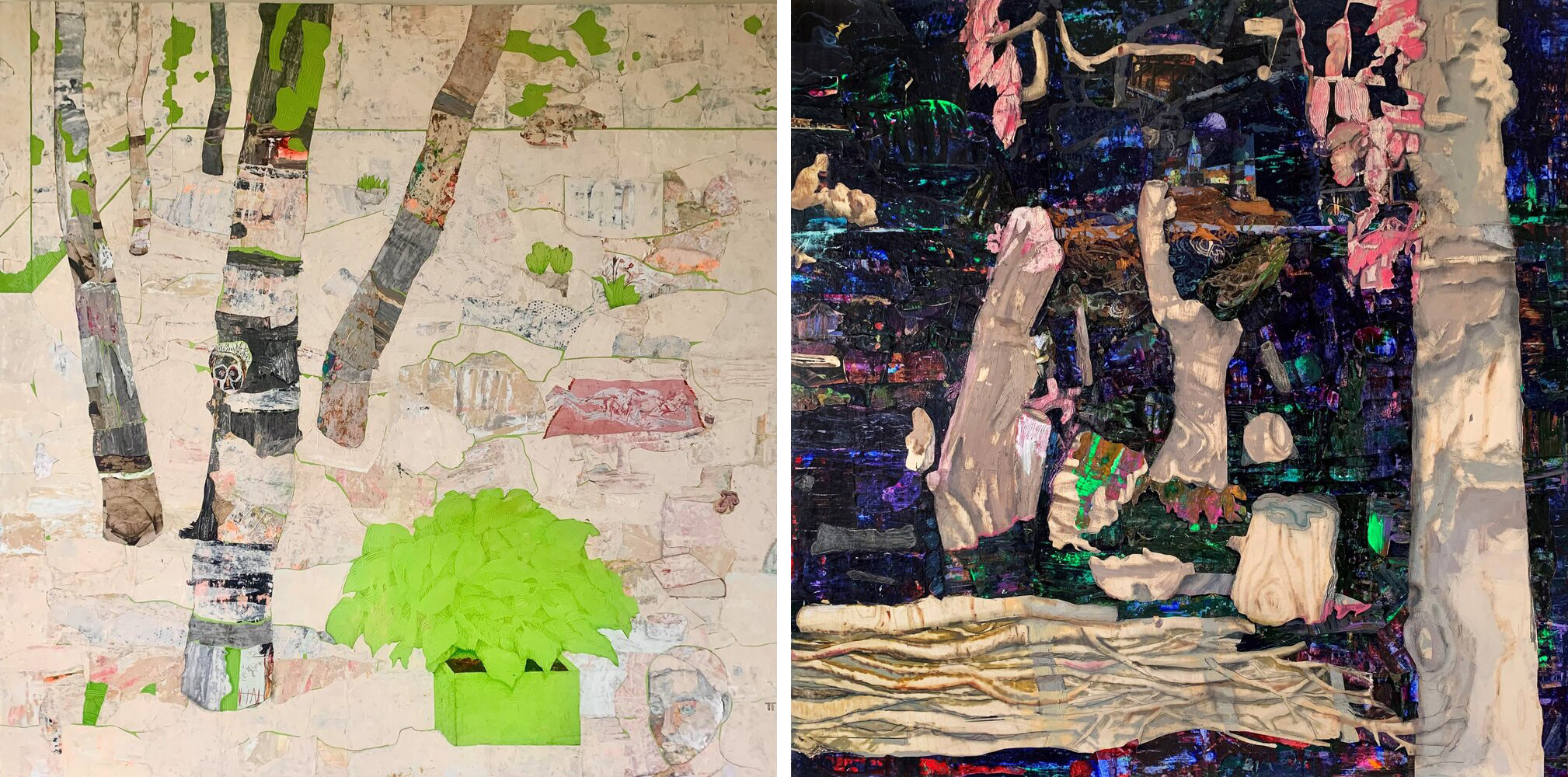
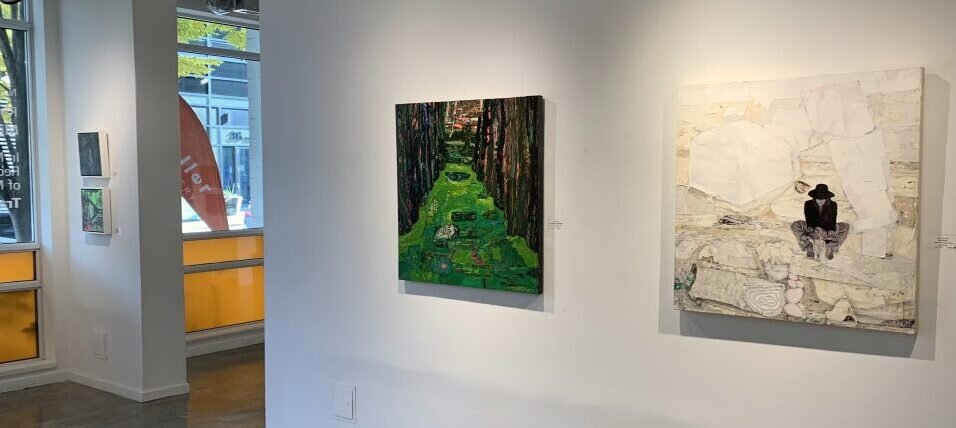
Interior and exterior co-mingle here, as though time has eroded the barriers of man-made vs nature made, into one compatible environment. Organic life and beings are regenerated into something “other”. In “Of Sand And Stone”, new amalgamated life forms and mosses sprout throughout the arid landscape, seeping into the dry mud wall. A figure lies upon a beach blanket with transistor radio and a nice cool drink, again traversing time with a welcome injection of pop culture.
“If You See The Pink Tree (You’ve Gone Too Far)” is another good example of her sense of irony. This piece relates to driving too far and missing the next left turn. You’ve gone so far in fact; you find yourself in a different realm altogether. Where floating tree stumps and signs of life fight to reassemble and once again tether themselves to the earth. A planted flag reads “Point Of No Return”, a clear message of Thomson’s fear of our negligence in protecting our planet from demise.
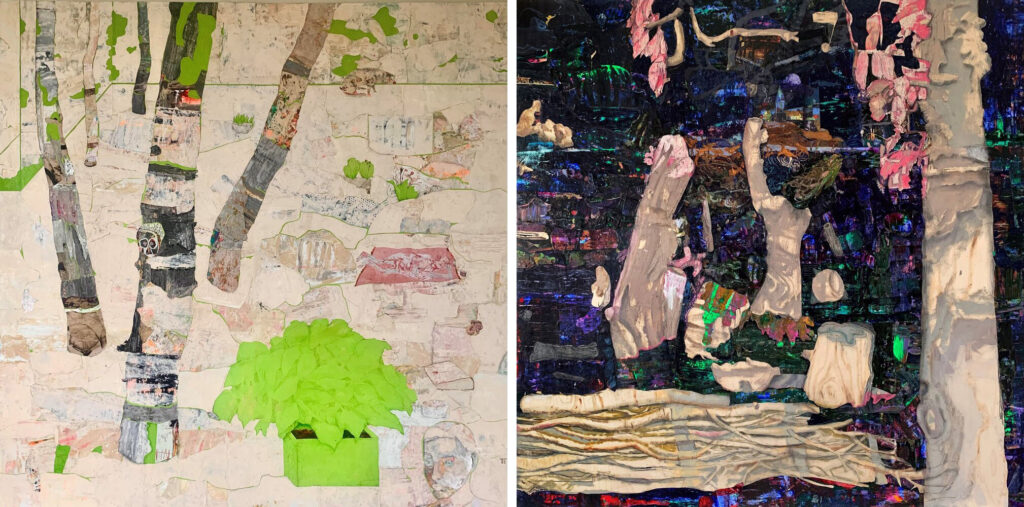
(L-R) Tracy Thomson, Of Sand And Stone, mixed media on wood panel, 60 x 60 inches & If You See The Pink Tree (You’ve Gone Too Far), mixed media on wood panel, 48 x 48 inches
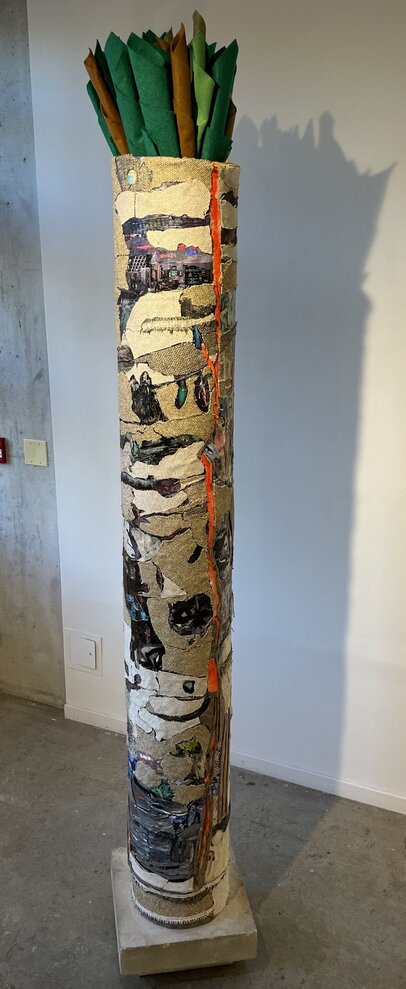
The tree trunk from “Of Sand And Stone” steps out of the two dimensional composition and becomes three dimensional in “Family Tree.” It is a one-of-a-kind family tree, really just a trunk covered by the mainly abstract motifs of Thomson’s paintings. Very strange indeed, as there are no branches coming out of the trunk, only fabric tubes inserted into the cylinder’s opening at the top; a true embodiment of Thomson’s fear of degeneration.
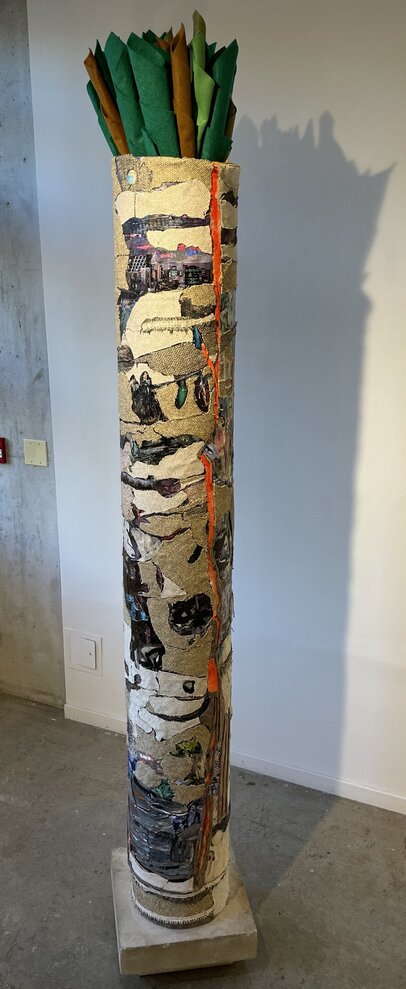
Tracy Thomson, Family Tree, mixed media on construction tube, 96 x 13 inches
Thomson wishes for a world into which we can adapt and move forward safely and thoughtfully into the future. As she says: “We’re always hopeful, right? No matter what happens, we humans can always find hope hiding somewhere and it is this hope that creates change, so that we can be prepared for what may transpire in the future.”

(L-R) Tracy Thomson, They Dreamt Of Trees and Future Projections, both mixed media on wood panel, 12 x 12 inches
Her process is one of happenstance. Images appear of their own volition and when they do, the element of surprise is a driving force. She states that “whatever appears is meant to be there for whatever reason and I’m careful not to edit these things out, even if they don’t quite make sense at the time, that’s like life.” She considers her involvement in the creative process, similar to “just another brush or tool, I’m there to facilitate the work, not control it.”
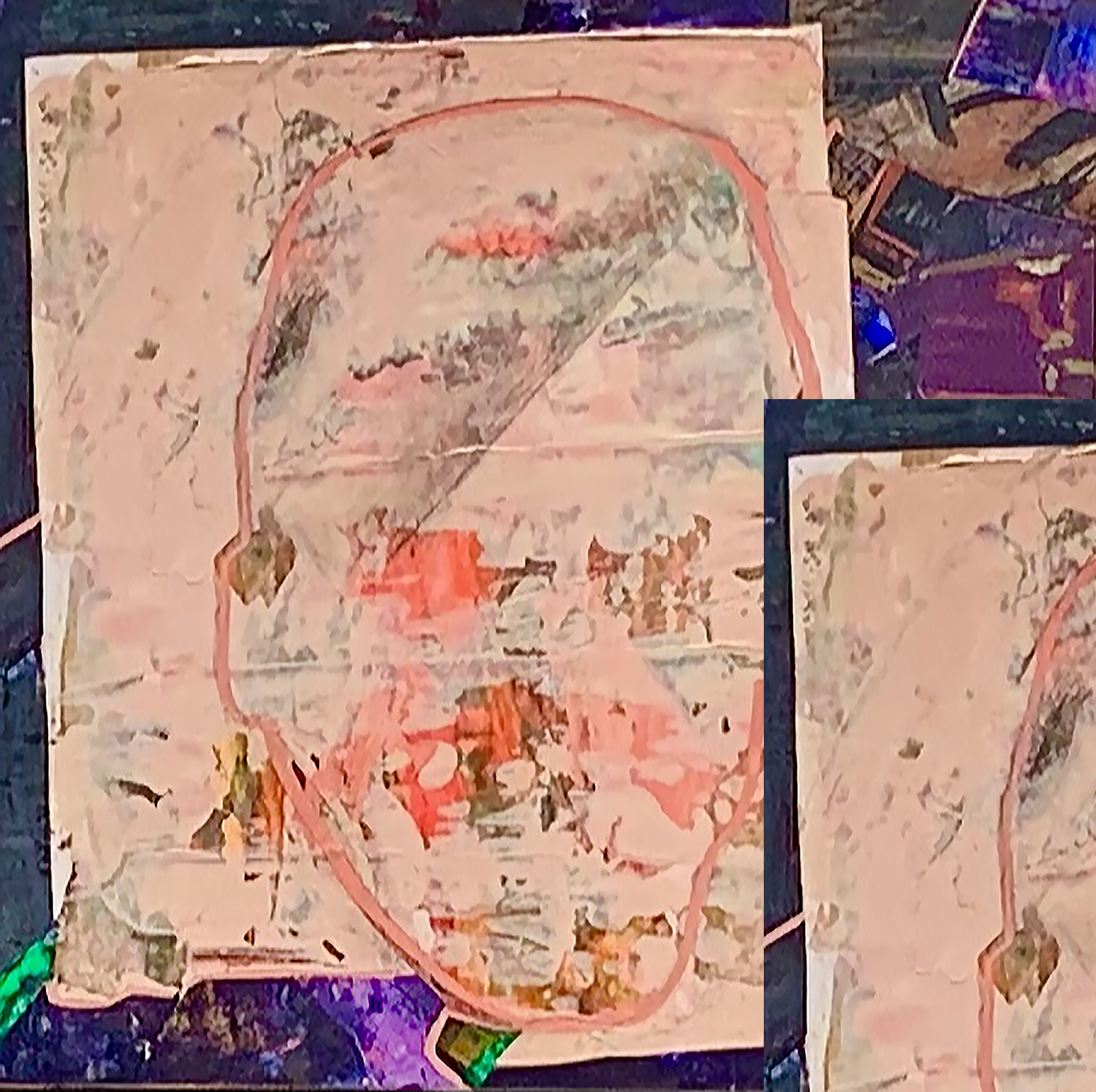
For example, for “Bone Of My Bone, Flesh Of My Flesh”, she had no intention of creating a portrait and when it began taking shape, she identified it as her great- great Uncle, Tom Thomson. As she explains, “I don’t pre-plan these things but when they happen, they’re a bit of magic!”

Tracy Thomson, Bone Of My Bone, Flesh Of My Flesh, mixed media on wood panel, 12 x 12 inches
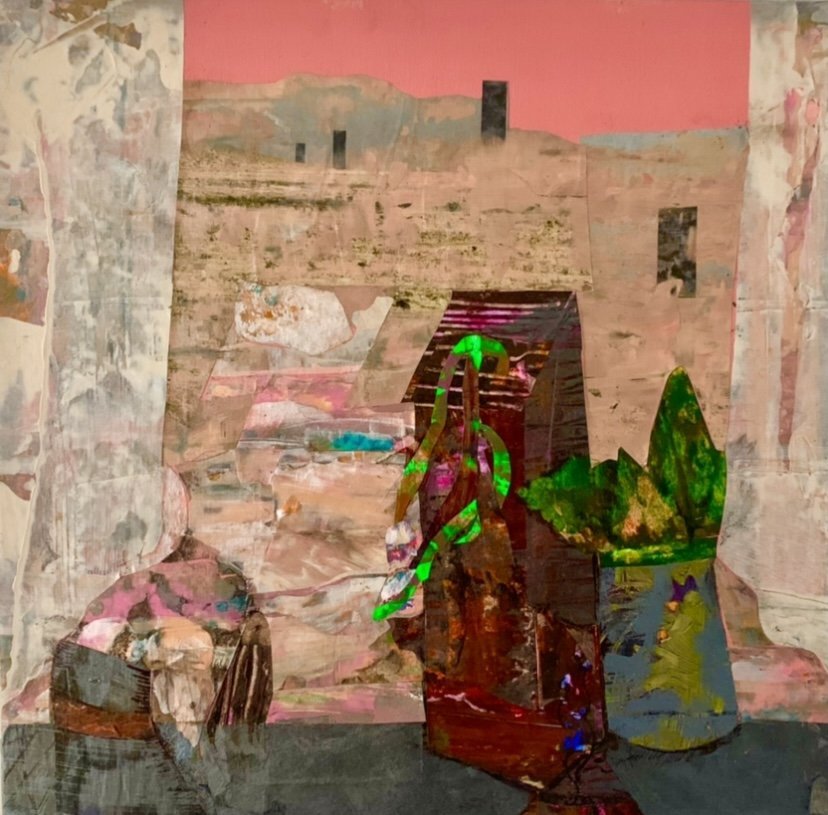
“White Curtain” is an example of her future world constructs. She told me, “This is like something in the desert, and these (containers) are representative of energy stations where we can plug ourselves in…These thoughts of the future can at times be unsettling. I find humour combats the unease.” In this piece she keeps the traditional landscape of a desert, however, it is a reconstructed futuristic view which is up for interpretation, so the viewer can decide what to see in the future.
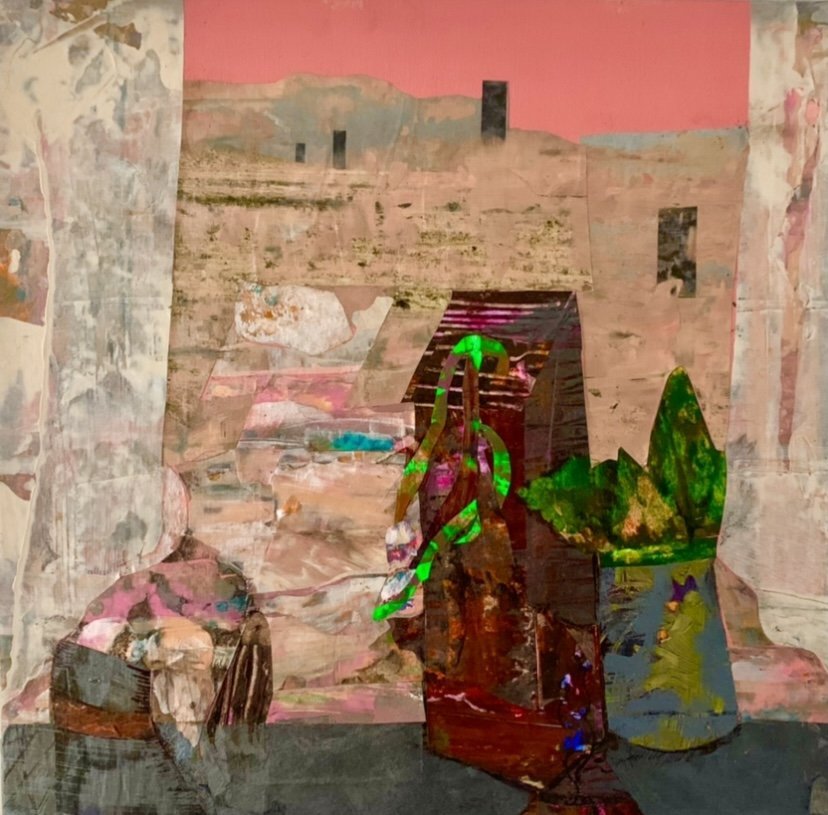
Tracy Thomson, White Curtain, mixed media on wood panel, 12 x 12 inches
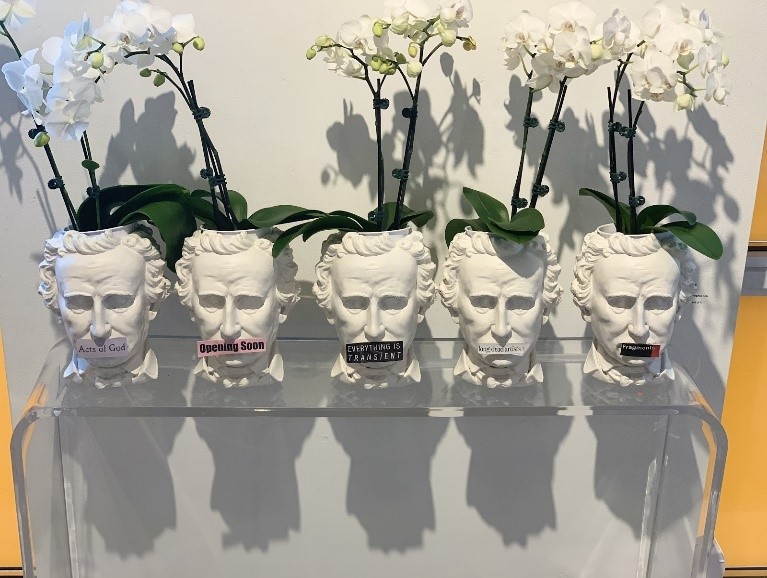
Also in this show, are 5 white orchids growing out of five white ceramic heads. Placed all in a line, like sentinels, standing guard for peace. The white Orchid symbolizes hope and innocence. Called “Talking Heads” for the word headlines attached to the mouth of each head.
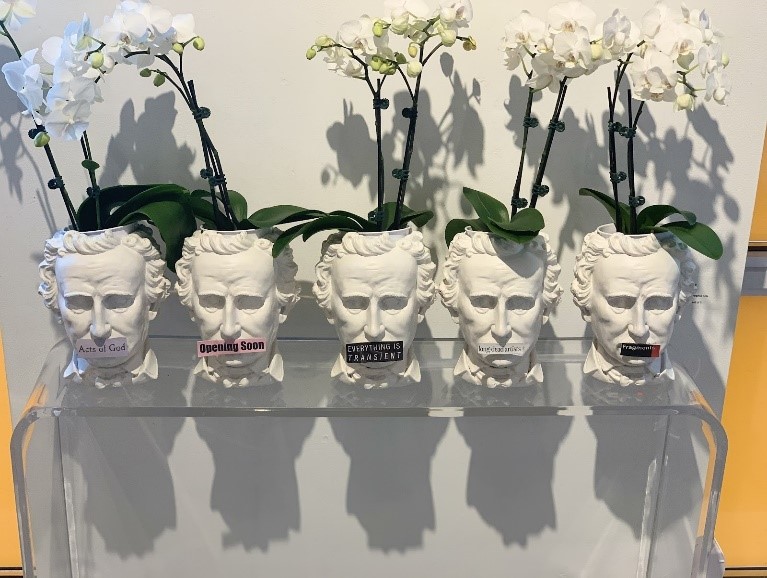
Tracy Thomson, Talking Heads (L-R) Everything Is Transient, Fragments, Acts of God, Opening Soon and Long Dead Artists, each hand-painted ceramic pot, 20 x 6 inches
Thomson summarizes her artist talk with, “I am so consumed by all the natural disasters everywhere, all the eco-stuff that is so prevalent right now. That really does scare me.
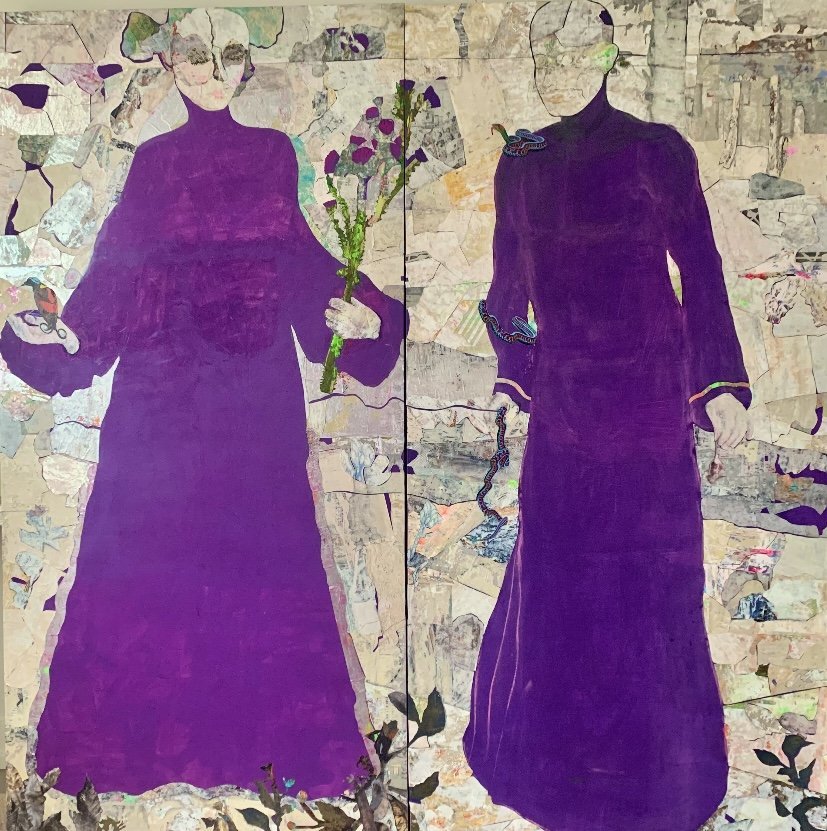
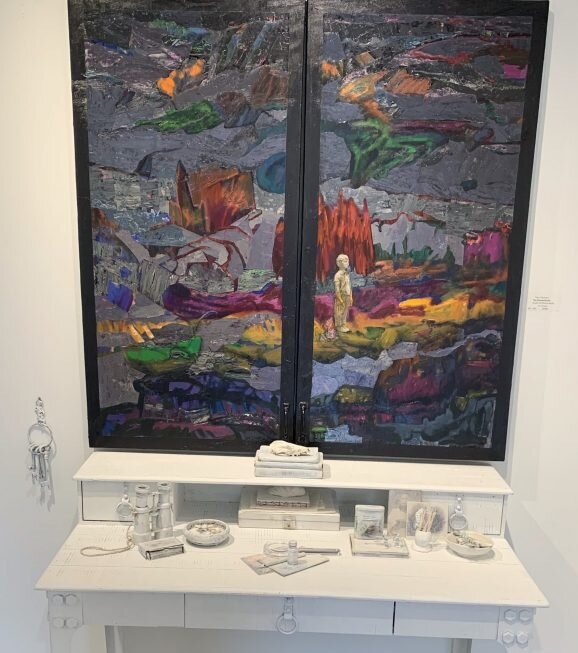
When listening to Thomson explaining her vision and how she arrived at each piece of work, I realize the true scope of her search for eternal hope. She is searching not only for a way to cope with the impact of the world’s treacherous waves of conflict, but also to instill in the viewer a sense of acceptance of being, and to find trust in the natural order and optimism in the face of uncertainty. In her powerful diptych “Ever After”, an Indonesian Bird of Paradise sits placidly in the female figures hand. While a snake uncoils the arm of the male figure, a mouse in the other hand. “The enchanted mysteries of what may lie ahead. The uncertain treachery of such places. This is what fuels me”.
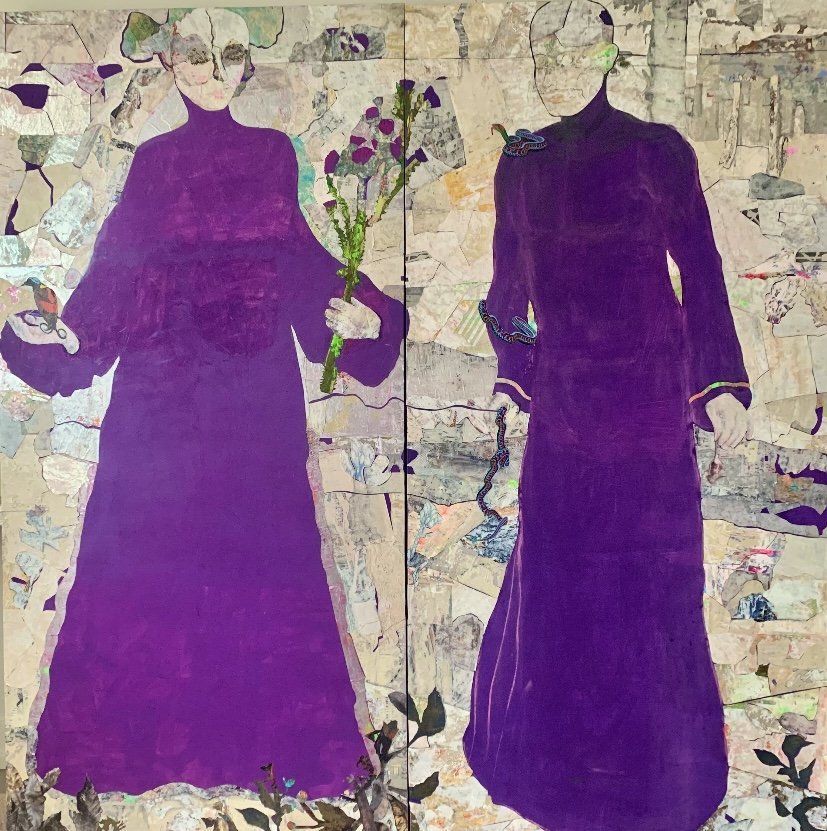
Tracy Thomson, Ever After, mixed media on two wood panels, 72 x 36 inches
It is a show utterly worth seeing especially if you enjoy meaningful art with strong imagery.
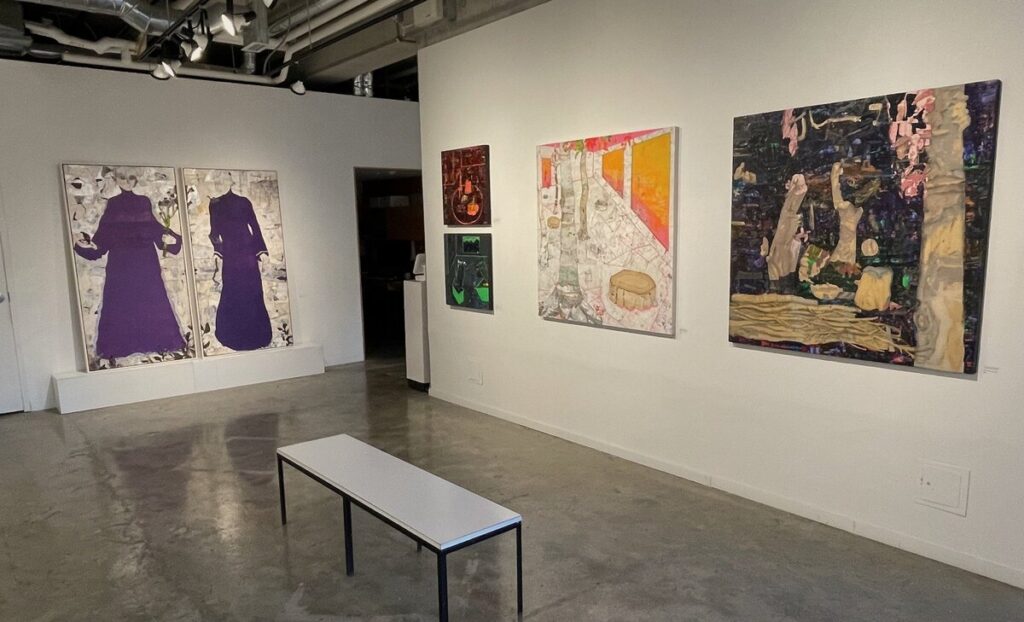
Installation view of Tracy Thomson, Hope Springs Eternal
In My Room: The Reconstruction of Memory
(exhibition at Propeller Art Gallery, 30 Abell Street, Toronto)
November 3 – 21, 2021
Review by Bronwen Cox / Artoronto.ca link
“Imaginary Interiors: Tracy Thomson at Propeller Gallery“
The word room, for many of us, has a different significance after the past year. Encapsulating feelings of isolation and claustrophobia, but also safety and familiarity, our interiors will never feel the same after COVID-19. In My Room: The Reconstruction of Memory, Tracy Thomson’s solo show at Propeller Gallery, explores various imagined interior scenes through mixed media. Each complex image is drastically different from the next, conveying a multitude of emotions, ideas and questions. These works are built up of layers of mixed media and acrylic oil, with vibrant colors and strange shapes. Varying in size from small-scale to larger-than-life, each interior provides an intimate look into Thomson’s imagination and reality. Each room conveys a different mood, on a spectrum from dark to light.
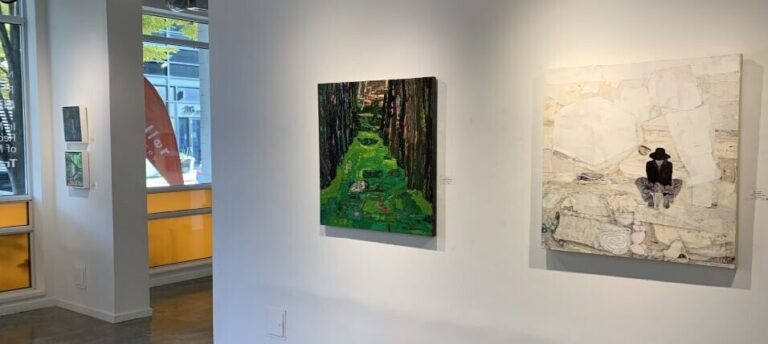
Installation view of Tracy Thomson, In My Room: The Reconstruction of Memory at Propeller Gallery
Tracy Thomson is a Toronto-based painter and mixed media artist. Her practice aims to “create works that allow her mind into unknown territory”. As opposed to collage, she calls her compositions “reconstructions”; pulling apart painted paper and various materials, images are slowly and methodically turned into complete scenes. In the gallery’s exhibition statement, she described her process, “In my reconstructions, I created imaginary rooms by making little dioramas, pieced together with paint, paper, glue…and a healthy dose of love and hope! Decorated with objects that would pertain to the person inhabiting the room or simply experiencing that room, from a distance.”
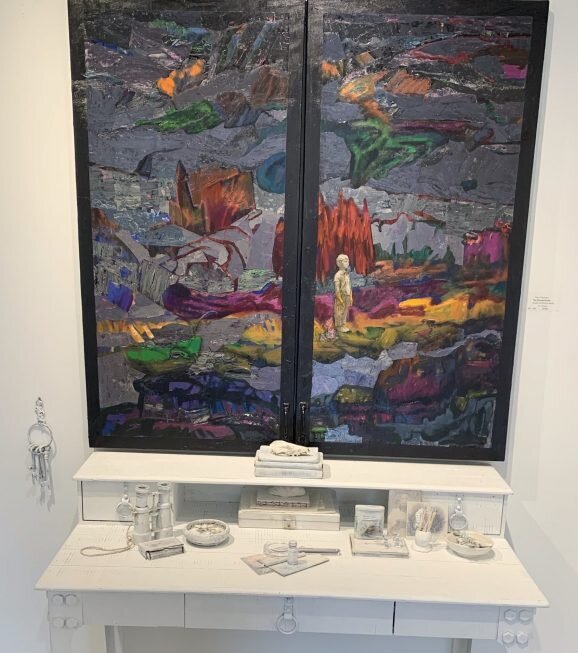
Installation view of Tracy Thomson, In My Room: The Reconstruction of Memory at Propeller Gallery
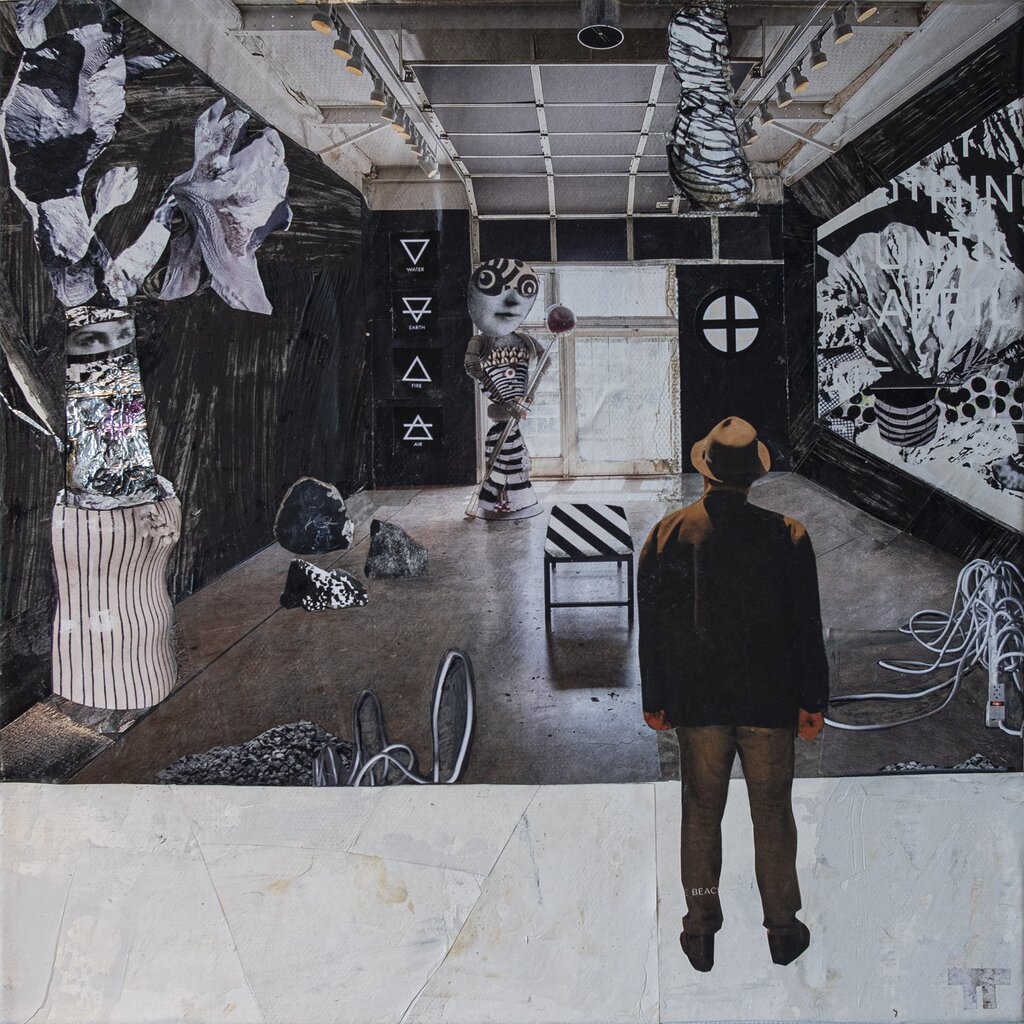
One of the most captivating works in the exhibition is The Manichaean, a figurative piece, in a mostly black-and-white setting with eerie, colourless wallpaper, alchemical symbols on the wall and cold, industrial flooring. A male figure in a jacket and hat stands at the entrance, his back to the viewer, standing on ground that is lighter than the rest of the floor, as if suspended in a space between canvas and reality. Before him are surreal, organic shapes, rocks, an isolated table, and a vase with eyes. In front of the window, a figure with a woman’s face, half covered with stripes and eyes made of spirals looms over the scene, reminiscent of a hermetic Hannah Höch. The image is haunting, and terrifyingly inviting.
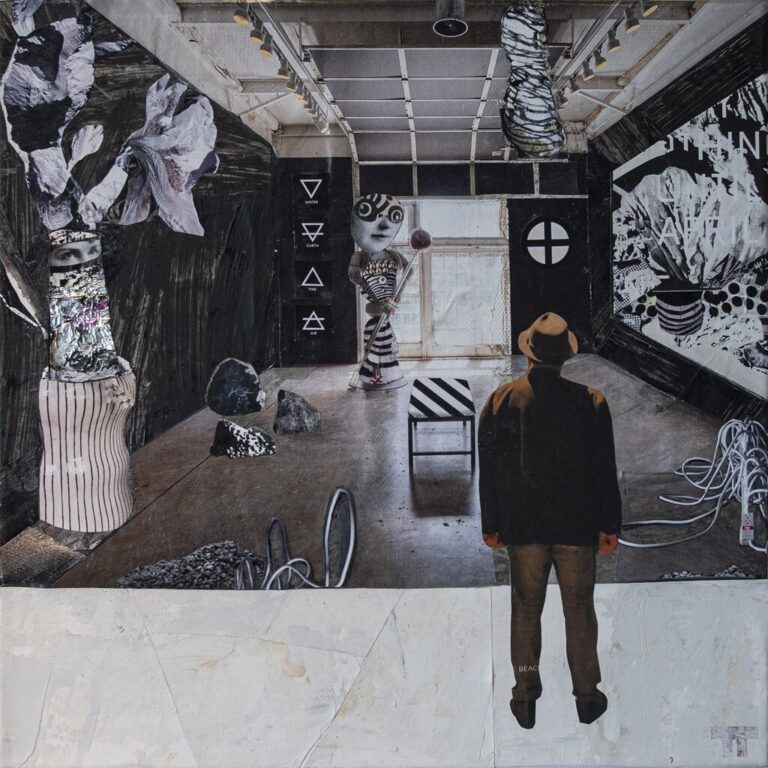
Tracy Thomson, The Manichaean, 2021, acrylic oil mixed media on canvas, 12” x 12”
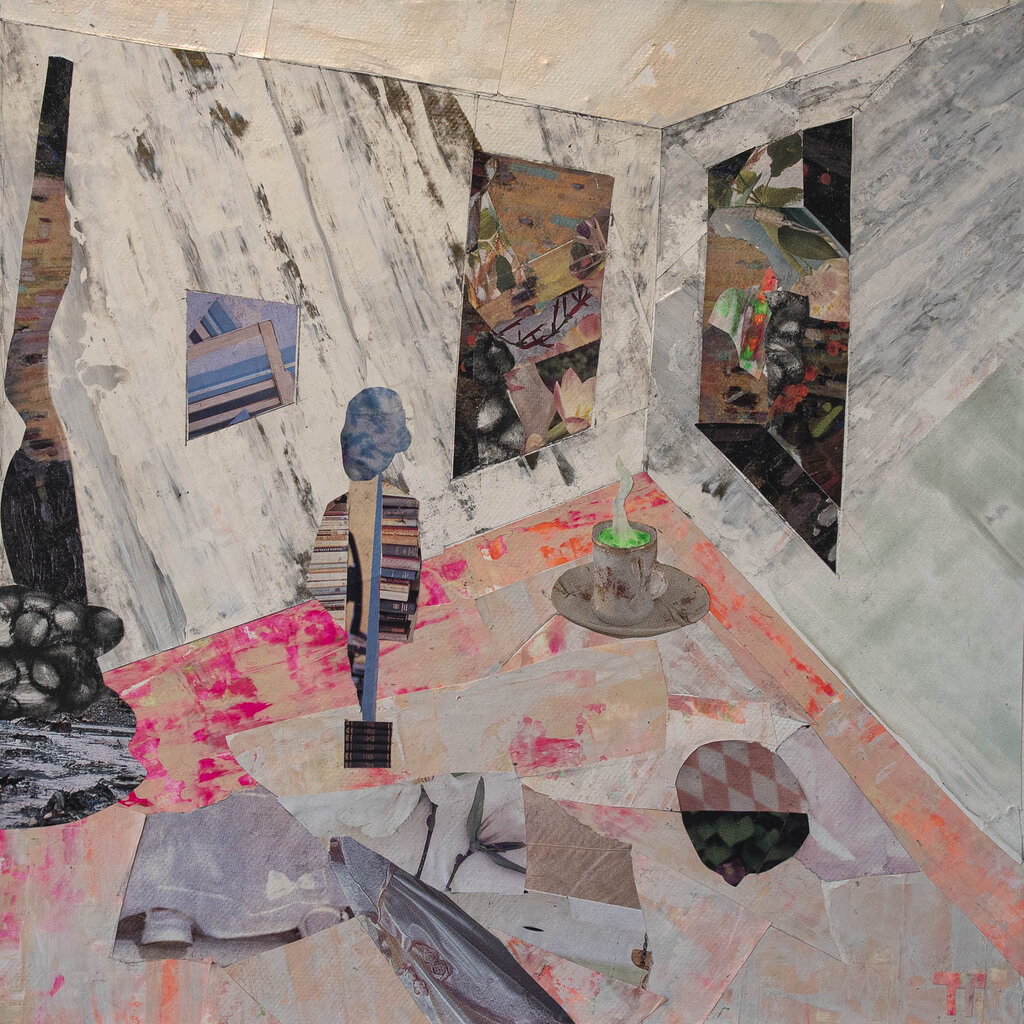
The Gallerist is a much less foreboding, though no less intriguing image. Here, the interior is brighter, with fun, neon hues of pink and orange splashed across the floor, and beautifully textured white marbled walls. The gallerist is at first barely noticeably a human figure; has a head-shaped cut-out that looks like clouds, and the body is composed of books. On the walls, there are paintings reminiscent of Thomson’s own and an abstract sculptural form. In the corner there is a steaming mug on a saucer filled with neon green liquid: perhaps it’s a trendy cup of matcha, but its unnatural hue suggests something otherworldly and powerful.

Tracy Thomson, The Gallerist, 2021, acrylic oil mixed media on canvas, 12” x 12”
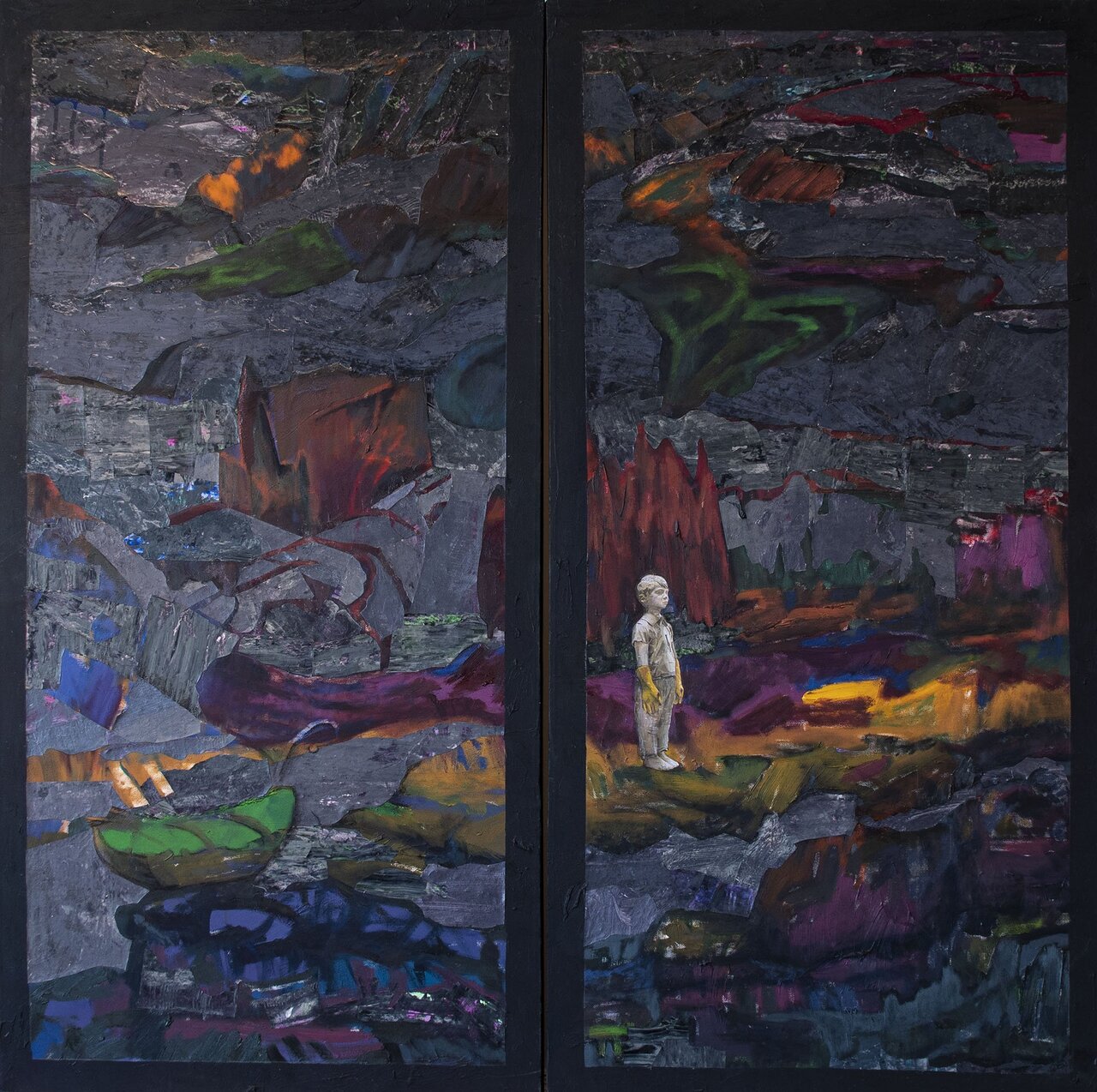
One of the few large-scale works in the show, The Somnambulist, depicts a complex, dark and fantastical dream-scape, framed as if the viewer is looking out of a window. The darkness and vastness of the landscape dwarfs the figure within, a pale, monochrome boy with yellow gloves standing alone and on guard; he appears not of this world, a mere passerby. Near him is a boat – is he coming, or going? The canvas is filled with colourful, abstract shapes and hints of rich, jewel-like textures.
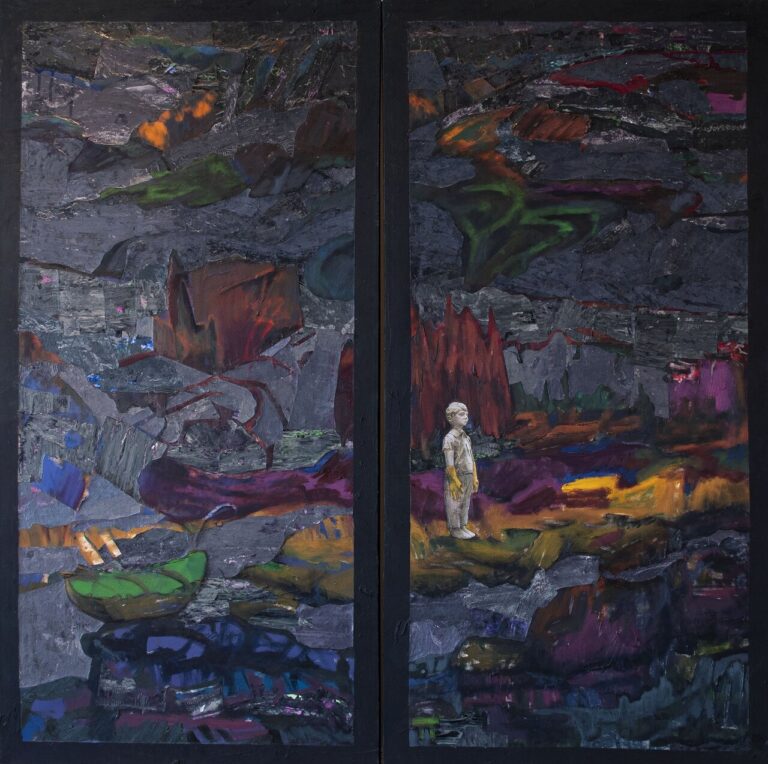
Tracy Thomson, The Somnambulist, 2021, acrylic oil mixed media on canvas, 48” x 48”
Thomson’s solo show is a fantastical escape from the quotidian interiors of reality. Each canvas has its own unique and amazing narrative. One could get easily lost for hours in these mesmerizing reconstructions, imagining themselves as the figures in the work, enriching their own imagination.
 TRACY THOMSON | Artist